Paint calculator: how much paint for a room?
Enter the room size and the number of doors and windows. The result is the wall paint for the coats you choose, rounded up to the gallons and quarts you can buy.
Enter your measurements
More options: Door · Window · Skip …
- Paint needed
- 1.91 gal (7.22 L)
- Wall paint, cans of the size you chose
- 2 cans · 1-gallon
- Area painted (one coat)
- 334 sq ft
- Paint per coat
- 0.95 gal
- Coverage used
- 350 sq ft/gal
2 × (12 ft + 12 ft) × 8 ft = 384 sq ft of wall − 1 door × 20 sq ft − 2 windows × 15 sq ft = 334 sq ft
334 sq ft × 2 coats ÷ 350 sq ft/gal = 1.91 gal
Buy 2 gallons (2 cans of the size chosen)
- Coverage is per coat on a smooth, primed wall. Fresh drywall, flat old paint and textured walls soak up more, so if you are near a can boundary, round up.
- Old house? If it was built before 1978, read lead paint safety before you sand or scrape: EPA advises assuming old paint contains lead until it is tested.
Quick answers for common sizes
| Example | Answer |
|---|---|
| How much paint for a 12x12 room | 1.91 gal: buy 2 gallons (walls only, 2 coats) |
| How much paint for a 10x10 room | 1.54 gal: buy 2 gallons (walls only, 2 coats) |
| How much paint for a 10x12 room | 1.73 gal: buy 2 gallons (walls only, 2 coats) |
| How much paint for a 12x14 room | 2.09 gal: buy 2 gallons + 1 quart (walls only, 2 coats) |
| How much paint for a small bathroom | 0.73 gal: buy 1 gallon (walls only, 2 coats) |
| How much paint for a 12x12 room and ceiling | 1.91 gal walls + 0.82 gal ceiling, 2 coats |
| How many litres of paint for a 10x12 room | 6.52 L: 1 × 5 L + 2 × 1 L (walls, 2 coats) |
Paint for this room by wall height
| Wall height | Area painted (one coat) | Paint needed | Buy (gallons and quarts) |
|---|---|---|---|
| 8 ft | 334 sq ft | 1.91 gal | 2 gallons |
| 9 ft | 382 sq ft | 2.18 gal | 2 gallons + 1 quart |
| 10 ft | 430 sq ft | 2.46 gal | 2 gallons + 2 quarts |
| 12 ft | 526 sq ft | 3.01 gal | 3 gallons + 1 quart |
Doors and windows are taken off at typical sizes (20 sq ft and 15 sq ft); change them under More options if yours are bigger. The coverage field starts at 350 sq ft per gallon, the low end of what most wall-paint data sheets list. Type the figure from your can for the best answer. New to this? Paint words explained.
How much paint for a room: the formula
Paint is bought by volume but used by area. Work out the wall area, multiply by the coats, and divide by how many square feet a gallon covers.
wall area = 2 × (length + width) × height − doors − windows
paint (gal) = wall area × coats ÷ coverage (sq ft per gal)
1 US gallon = 4 quarts ≈ 3.79 L  ·  350 sq ft/gal ≈ 8.6 m²/L
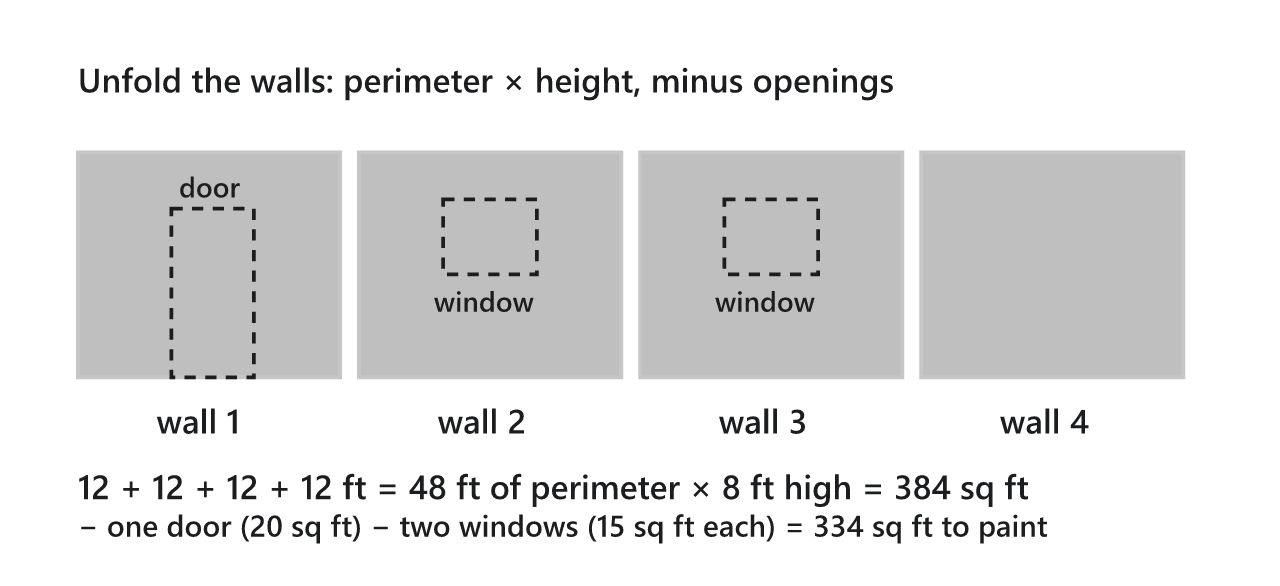
Example: a 12 × 12 ft bedroom with 8 ft walls has 2 × 24 × 8 = 384 sq ft of wall. Take off one door (20 sq ft) and two windows (30 sq ft) and 334 sq ft is left. Two coats at 350 sq ft per gallon is 668 ÷ 350 = 1.91 gallons, so you buy 2 gallons. That one is worked through in full on how much paint for a 12x12 room.
Worked examples
- How much paint for a 10x10 room: the small bedroom or office where a gallon is not quite enough.
- How much paint for a 10x12 room: the size most new-build second bedrooms come in.
- How much paint for a 12x14 room: where the order tips past 2 gallons.
- How much paint for a small bathroom: tile and the tub surround take a big bite out of the wall.
- How much paint for a 12x12 room and ceiling: walls and ceiling in one order.
- How many litres of paint for a 10x12 room: the same job in metric tins.
What the coverage on the can means
Every manufacturer prints coverage as a range per coat, measured at a set wet film thickness on a smooth, sealed surface. Rough, porous or unprimed surfaces drink more paint, and deep colors often need an extra coat to hide. These are the figures from the current data sheets of three common lines:
| Product (data sheet) | Coverage per coat | What the sheet says about coats |
|---|---|---|
| Sherwin-Williams ProMar 200 Zero VOC (flat, eg-shel, semi-gloss) | 350–400 sq ft/gal at 4 mils wet | 1 coat primer + 2 coats on new drywall |
| Benjamin Moore Regal Select Eggshell | 400–450 sq ft/gal at 3.8 mils wet | 2 coats for full color development |
| Behr Premium Plus Interior Flat | 250–400 sq ft/gal | Range depends on application method and porosity; spray loss not included |
That spread is why the calculator asks for the number on your can. At 400 sq ft per gallon the 12 × 12 room above needs 1.67 gallons; at 250 it needs 2.67. When in doubt, plan on the low end of the range and keep the leftover for touch-ups.
How many coats?
- New drywall: one coat of primer, then two finish coats. That is the system on the ProMar 200 data sheet; the primer calculator does the first step.
- Same or similar color over sound paint: often one coat will do. Two give a more even sheen.
- Big color change, especially light over dark or a deep red or yellow: two coats, and the data sheets suggest a tinted primer first.
- Patched walls: spot-prime the patches, or they can show through as dull “flashing” in an eggshell or satin finish.
Tips and common mistakes
- Measure the room, not the floor plan. Bay windows, closets and soffits all add wall; a walk-in closet painted the same color is often another 100–150 sq ft.
- Don’t subtract small things like outlets and switch plates. Do subtract big openings, fitted wardrobes and tiled areas (use Other wall area under More options).
- Buy all the paint from the same batch, or mix the cans together before you start. Color can shift slightly between batches.
- Ceilings and trim are usually different products. Price them with the ceiling paint calculator and the trim paint calculator.
- Ventilate while you paint and for a day or two after: open windows and run a fan blowing out. Behr’s data sheets note that most emissions happen during painting and in the 48 hours after.
For whole-job numbers, the paint coverage chart lists gallons per room size, and how to paint a room walks through the order of work.
What you’ll need
- Paint roller frame and covers (9 in)Budget price
A sturdy 9 in frame and a few 3/8 in nap covers handle smooth drywall. Rougher walls and ceilings want 1/2–3/4 in nap, as the data sheets suggest.
See options on Amazon (opens in a new tab) - Angled sash brush (2–2½ in)Budget price
For cutting in along ceilings, corners and trim. A nylon-polyester brush is what the latex data sheets recommend.
See options on Amazon (opens in a new tab) - Painter’s tape (multi-surface)Budget price
Masks trim, ceilings and glass. Pull it at an angle while the last coat is still slightly soft for the cleanest line.
See options on Amazon (opens in a new tab) - Canvas drop clothBudget price
Canvas stays put and soaks up drips; plastic is cheaper but slippery underfoot and spreads wet paint.
See options on Amazon (opens in a new tab) - 5-gallon bucket and roller gridBudget price
Once a job needs more than two gallons, boxing the paint in a bucket keeps the color consistent and a grid replaces the tray.
See options on Amazon (opens in a new tab)
As an Amazon Associate we earn from qualifying purchases. Links to products are affiliate links — they cost you nothing extra and help keep these calculators free.
Frequently asked questions
How many gallons of paint do I need for a 12x12 room?
About 2 gallons for two coats on 8 ft walls, at 350 sq ft per gallon with a door and two windows taken off. The full working, and the 9 ft and one-coat versions, are on how much paint for a 12x12 room.
Should I subtract doors and windows when estimating paint?
Yes for the big ones. A standard door is about 20 sq ft and a typical window about 15 sq ft; in a small room that is 10–15% of the wall. Leave the trim around them for the trim paint calculator.
Is one gallon of paint enough for a bedroom?
Usually not for two coats. A gallon at 350–400 sq ft covers about 175–200 sq ft twice, which is less than the walls of even a 10x10 room (270 sq ft after a door and two windows).
Does paint-and-primer in one mean I can skip primer?
Not on new drywall or bare patches. Most self-priming paints are meant for previously painted walls; their data sheets still list a separate primer for new drywall. Check the system recommendations on your product’s sheet.
How much paint should I keep for touch-ups?
A quart or so per room is plenty. Label it with the room and the color formula, and store it where it won’t freeze.
Related guides
- How to paint a room: quantities, order of work and drying times
- Lead paint safety when painting an older home
- Paint coverage chart: how much a gallon covers, and gallons per room
- Paint sheen chart: flat, eggshell, satin, semi-gloss and gloss
- Door and window sizes for paint and drywall estimates
- Wallpaper roll sizes: single, double and European rolls
- Paint and drywall words, explained
Sources
- Sherwin-Williams, ProMar 200 Zero VOC Interior Latex Eg-Shel (B20 series), product data sheet (opens in a new tab) — Coverage 350–400 sq ft per gallon at 4 mils wet; two coats over primer on drywall; sheen 15–20 units at 85°.
- Sherwin-Williams, ProMar 200 Zero VOC Interior Latex Flat (B30 series), product data sheet (opens in a new tab) — Coverage 350–400 sq ft per gallon at 4 mils wet; sheen 1.5–3.5 units at 85°.
- Benjamin Moore, Regal Select Interior Eggshell (549), technical data sheet (opens in a new tab) — Coverage 400–450 sq ft per gallon at 3.8 mils wet; two coats for full color; eggshell 15–22 units at 85°.
- Behr, Premium Plus Interior Flat Paint (No. 1050), technical data sheet (opens in a new tab) — Coverage 250–400 sq ft per gallon depending on application method and substrate porosity; does not include spray loss.
- US EPA, Lead Renovation, Repair and Painting Program Rules (opens in a new tab) — Covers homes, child care facilities and kindergartens built before 1978; firms and renovators must be certified.